|
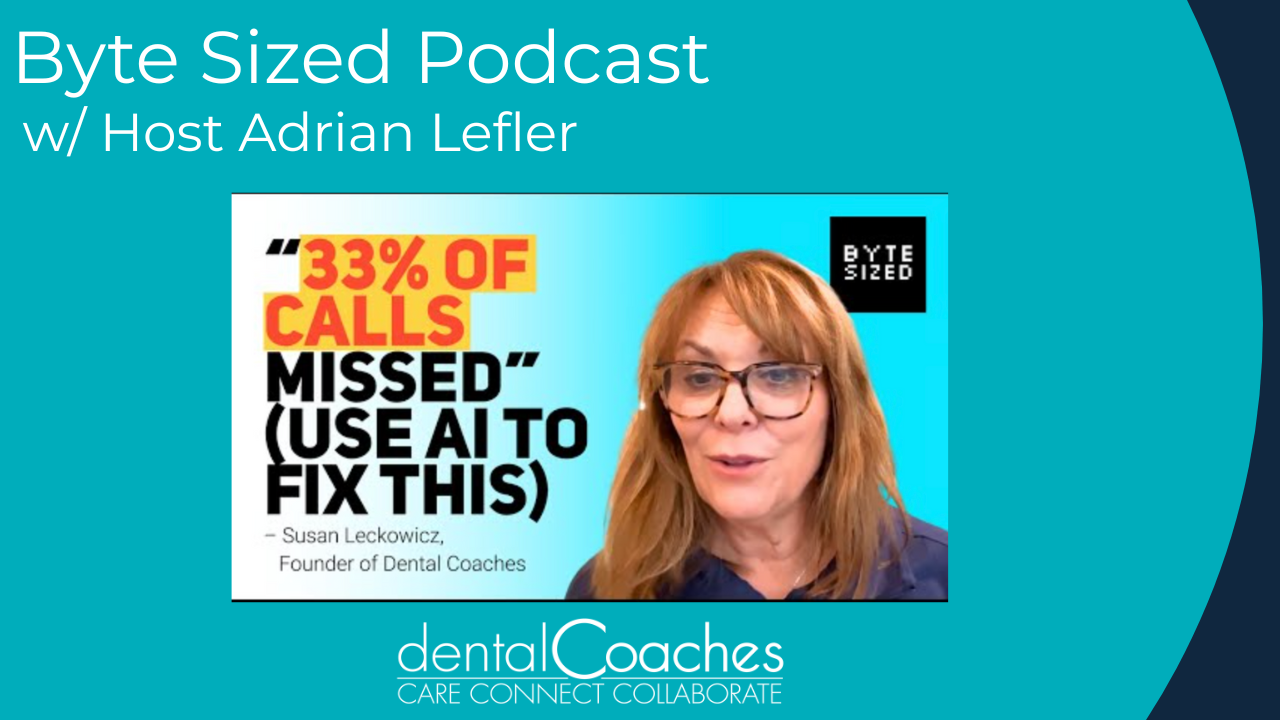
When Adrian Lefler invited me to join him on the Byte Sized podcast, I knew we were going to tackle something that's been on my mind constantly: how AI is completely changing the game for dental practices. What I didn't expect was how energized I'd feel walking away from our conversation, knowing that the practices willing to embrace this technology right now are about to leave their competition in the dust.
For over 25 years, I've been helping dental practices through Dental Coaches, and I've seen every challenge you can imagine. But the conversation Adrian and I had about AI agents really crystallized something I've been watching unfold: we're at one of those rare moments where early adopters are going to gain an almost unfair advantage.
The Problem That's Been Driving Me Crazy
You know what's been keeping me up at night? Watching brilliant dentists pour thousands into dental marketing to get their phones ringing, only to miss a third of those calls. A THIRD! As I told Adrian during our chat, "How can a team, especially smaller teams, help relieve some of those phone calls that can take up a lot of time; and oftentimes they are patients just confirming the time of their appointment?"
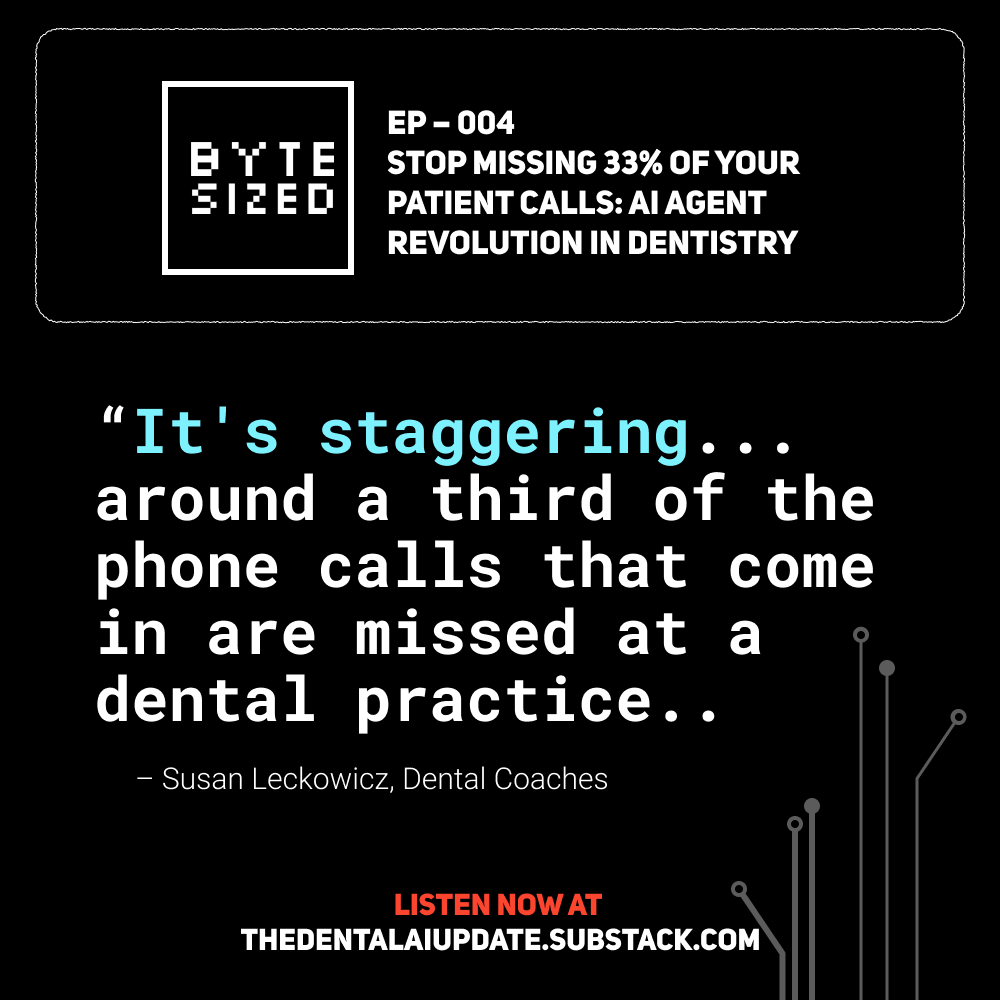
Think about it: Mrs. Johnson calls at 7 PM with a toothache. Your practice phone goes to voicemail. The practice down the street answers with an AI agent that schedules her for tomorrow morning. You just lost a lifetime patient worth potentially thousands of dollars because nobody was available to answer the phone.
This isn't theoretical for me. I see this cycle repeat itself in practice after practice across the country. We're talking about small teams that are already stretched thin, trying to provide excellent patient care while juggling phones, scheduling, insurance questions, and a dozen other daily tasks.
The AI Solution That Actually Makes Sense
Here's what got me excited during our conversation with Adrian: AI agents aren't trying to replace your team. They're designed to handle the routine stuff so your people can focus on what really matters, the patients in the chair.
"The agent tells people it's AI. No weird masquerading as human nonsense," Adrian pointed out, and that's exactly right. Modern AI agents are transparent about what they are, but they're incredibly effective at what they do. They can read your schedule, handle insurance questions, book appointments, and even manage emergency scheduling protocols.
What really impressed me was when Adrian mentioned that practices using tools like Annie AI are seeing zero missed calls. Zero! That means every potential patient gets a response, every current patient gets their questions answered, and your team isn't constantly interrupted by routine phone calls.
Beyond the Phone: AI is Revolutionizing Patient Care
But phone management is just the beginning. One of my clients recently had a teenage patient with six new cavities. Mom was freaking out because they'd just been to the dentist six months earlier. The doctor pulled up Pearl AI on the x-rays, and suddenly those cavities were lighting up "like a Christmas tree." Mom wasn't questioning the diagnosis anymore; she was asking her daughter about her brushing habits.
That's the power of AI in diagnostics. It's not about replacing clinical judgment; it's about providing visual proof that supports your expertise. When patients can see the technology backing up your recommendations, case acceptance improves dramatically.
The Marketing Game-Changer
As someone who's spent years helping practices improve their patient communications, I've been blown away by what AI can do for marketing and patient outreach. Instead of sending the same generic "you're overdue for your cleaning" postcards, practices are using ChatGPT to create reactivation campaigns that actually sound engaging and fun.
"Marketing becomes more effective," Adrian observed during our chat, and he's absolutely right. When you can create personalized, creative patient communications quickly and consistently, you're not just improving efficiency, you're improving results.
The practices I work with are saving hours per week on copywriting alone. They're creating social media posts that actually get engagement, writing patient emails that people want to read, and developing content that positions them as the go-to practice in their area.
Why This Changes Everything Right Now
Here's what I want every practice owner to understand: we're not talking about some far-off future technology. My clients are using this stuff today, and the results are immediate. Within the first week of implementing an AI phone agent, they're capturing calls they would have missed. Within 30 days, they're seeing improved case acceptance rates with AI diagnostics.
But here's the real kicker: while some practices are embracing AI, others are still operating the same way they did five years ago. Guess which ones are going to dominate their markets in 2025?
"The practices that adopt AI agents now are going to have a massive competitive advantage," Adrian said during our conversation, and that's exactly what I'm seeing in the field. It's not just about efficiency anymore; it's about meeting patient expectations for convenience and instant service.
What I'm Telling My Clients
After 12 years of helping practices create customized growth plans, I can tell you that AI represents the biggest opportunity I've seen for practices to work smarter, not harder. Start simple: try ChatGPT for your patient communications first. It's free, and you'll see results immediately.
Then explore AI phone agents like Annie AI for capturing every call, and diagnostic tools like Pearl AI for improving case acceptance. The key is to approach this systematically, just like any other practice improvement initiative.
The practices that embrace AI now while their competitors are still hesitant? They're going to be the ones laughing all the way to the bank. And honestly, if you're not at least exploring this technology, you're already behind.
Ready to Join the AI Revolution?
Thanks to Adrian and the entire Byte Sized podcast team for having me on. It was energizing to talk with someone who really gets how transformative this technology can be for dental practices.
If you want to hear our full conversation about AI agents, case acceptance, and the future of dental practice management, I encourage you to check out the complete episode on YouTube or listen on Spotify. And if you're ready to explore how AI can help your practice work smarter and grow faster, I'd love to help you create a customized plan that makes sense for your team.
The AI revolution in dentistry isn't coming, it's here. The question is: are you going to lead it or get left behind?
Frequently Asked Questions
How much does it really cost to implement AI in my dental practice?
The beauty of AI implementation is that you can start completely free. I always tell my clients to begin with ChatGPT for patient communications and content creation. From there, AI phone agents typically run $200-500 monthly, which is a fraction of hiring additional staff. When you compare that to the cost of missing even one new patient per month, the ROI is immediate.
Will my team resist switching to AI, and how do I handle that?
I've worked with hundreds of practices through major transitions, and staff concerns are completely normal. The key is showing your team that AI empowers rather than replaces them. When they see how AI handles routine appointment confirmations and insurance questions, they realize it frees them up to focus on patient care. Start small, involve them in the training process, and celebrate the wins together.
How quickly can I expect to see results from AI implementation?
In my experience, practices see immediate improvements in call capture within the first week of implementing an AI phone system. Case acceptance improvements with diagnostic AI typically show up within 30-60 days as your team gets comfortable with the technology. The biggest wins come after 90 days when everything is fully integrated and your staff is leveraging AI across multiple touchpoints.
Can AI really understand my practice's unique personality and procedures?
Absolutely! Modern AI systems are incredibly trainable. Just like onboarding a new team member, you teach the AI your scheduling protocols, insurance policies, emergency procedures, and even your practice's communication style. I've seen AI agents that perfectly match a practice's warm, family-friendly approach or their professional, clinical tone. The key is investing time upfront in proper training.
What if patients prefer talking to humans instead of AI?
What I love about today's AI solutions is the transparency. Good AI agents identify themselves right away, and most patients actually appreciate the honesty. They're getting their questions answered and appointments scheduled efficiently, which is what they really want. Plus, complex issues can always be transferred to your human team. It's about giving patients options, not replacing human connection.
Warmly,
Susan
|




Responses